Product Design · Design Systems · Logistics
Designing logistics products people are paid to use
Freight forwarders are mid-shipment, on a deadline, working out what a warehouse will charge them and whether the cargo fits on the plane.
- Year
- 2025 to 2026
- Role
- Product Designer, contract
- Context
- Turkish Cargo, air freight
- Surfaces
- Terminal charges, warehouse fees, loadability check
- Constraint
- Existing design system, in active use
- Status
- Shipped
Nobody churns, they just keep a spreadsheet open
Freight forwarders use these screens because it is their job. If a screen is slow or confusing they do not churn. They call someone, or keep a spreadsheet open next to the tool, and quietly stop trusting it. None of that shows up in adoption numbers, so I spent research time finding where people had already routed around the product.
Terminal charges
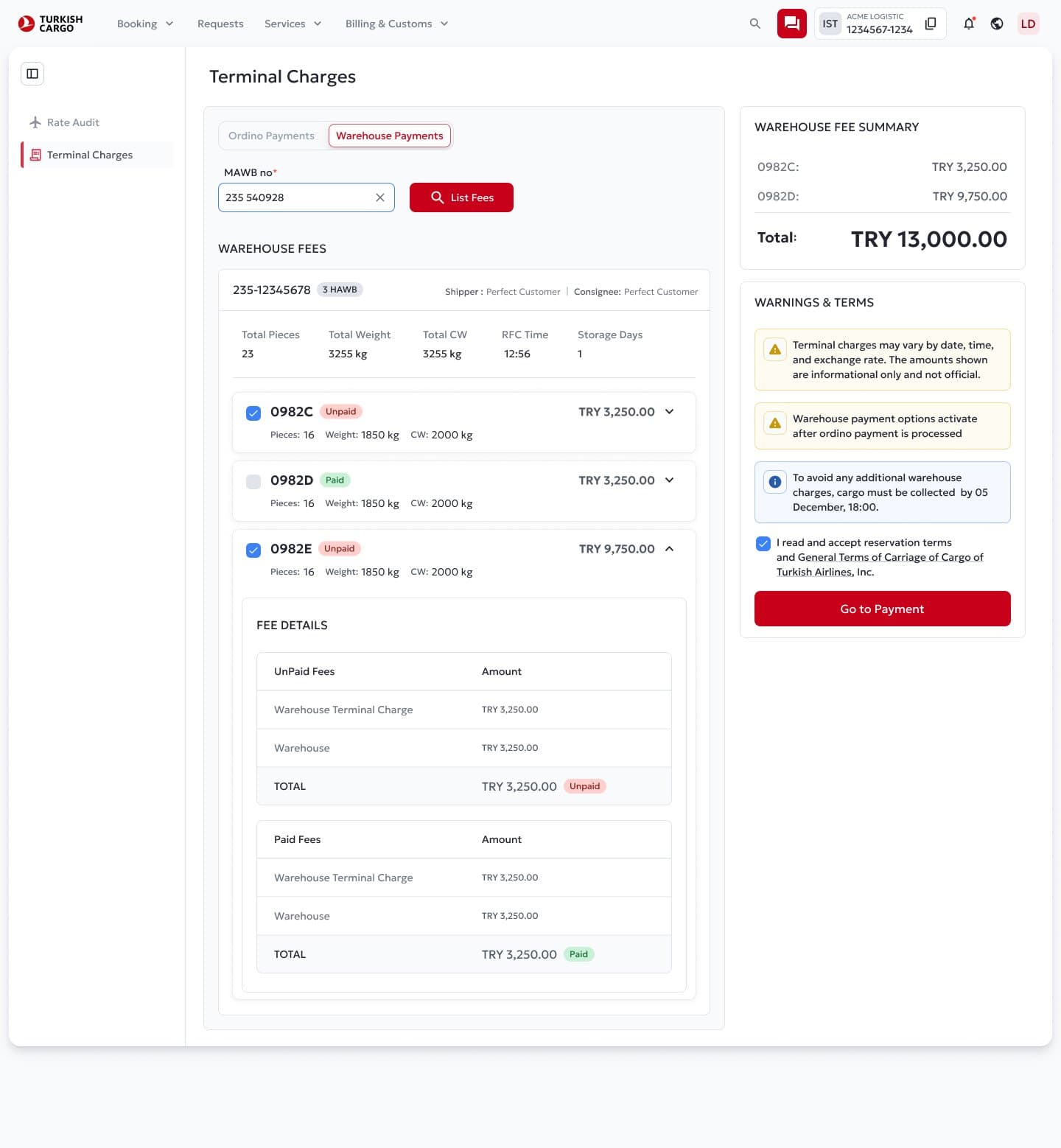
A single master air waybill can carry several house waybills, each with its own warehouse charges, each independently paid or unpaid. The user needs to answer one question fast: what do I owe right now, and on which shipment?
Paid and unpaid have to be visible without opening anything
Status sits on the collapsed row, so the total owed can be read down the list. Expanding a row is for checking the breakdown, not for discovering whether you owe.
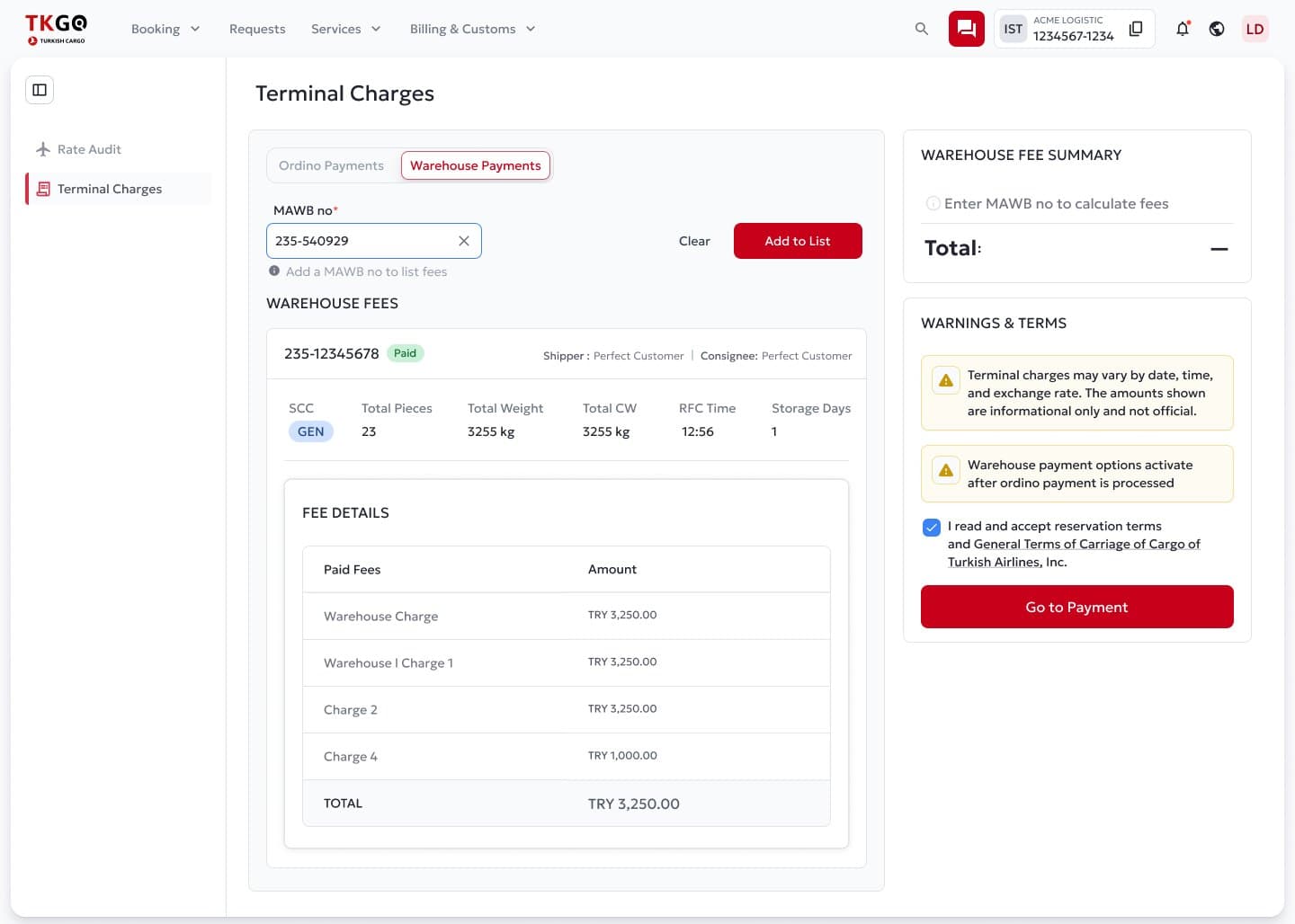
Summary first, breakdown underneath
The fee summary carries the number the user came for. Fee details underneath let them defend it to a client or an accounts team.
Say plainly when a figure is not binding
Terminal charges vary by date, time and exchange rate. The interface states that the amounts are informational rather than official.
Loadability: will it actually fit
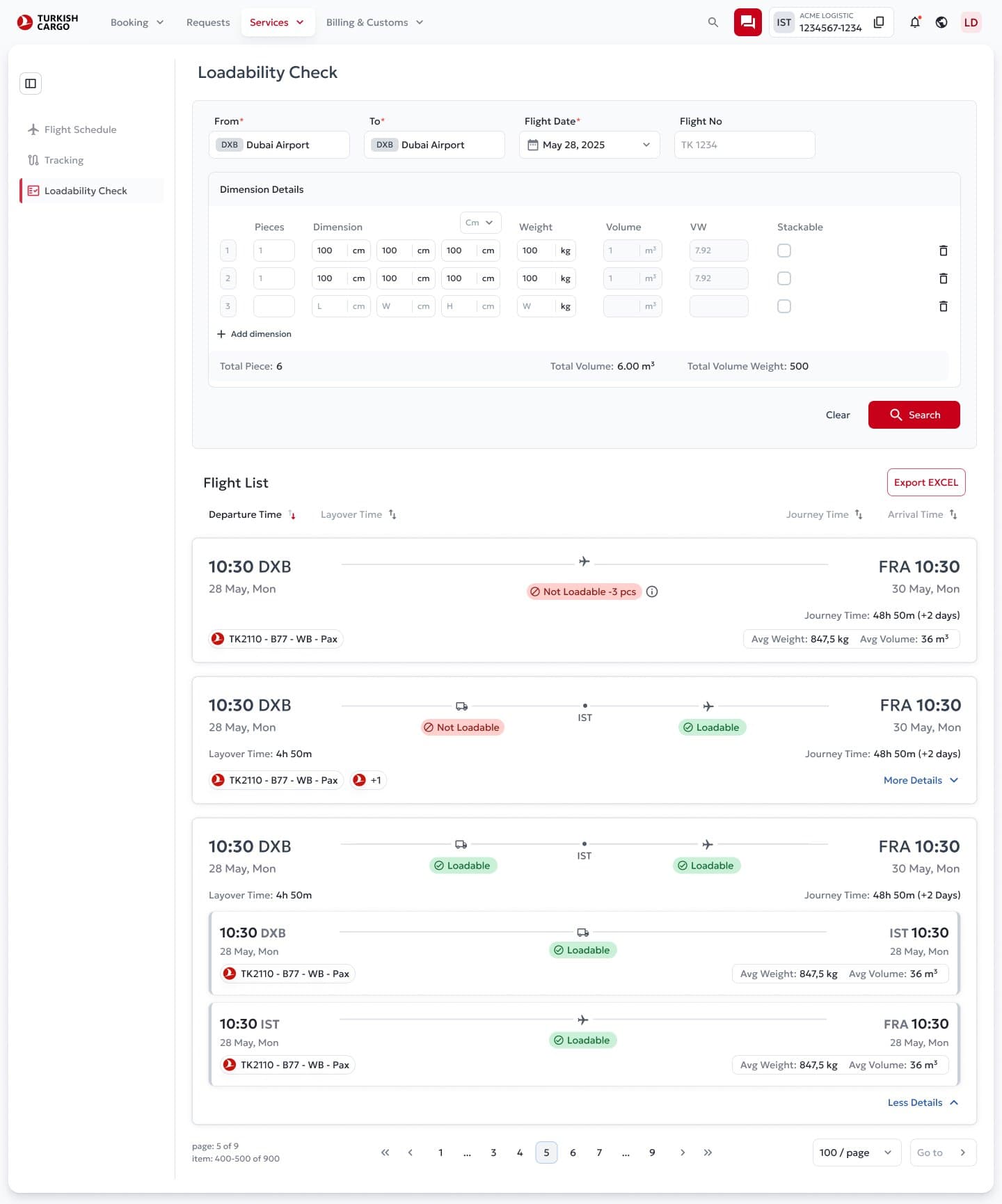
A forwarder enters dimensions and weight and needs to know which flights can carry the shipment. The complication is that a route is not one decision. A journey through a hub is a road leg plus a flight leg, and cargo can be loadable on one and not the other.
Loadability is per leg, not per route
Each segment carries its own status, so a route that fails is legible: the user can see it is the truck leg rather than the aircraft, and go looking for a different first leg instead of abandoning the route.
Say how much does not fit
Not Loadable minus three pieces is actionable. Not Loadable alone sends someone back to the form to guess.
Volumetric weight is calculated, never asked for
Volume and volumetric weight derive from the dimensions as they are typed. Asking a user to compute what the system can compute is where data entry errors come from.
Working inside a design system
Turkish Cargo has an established design system in active use across teams. My job was to improve these products without forking it. Consistency is what makes an unfamiliar screen legible to someone opening it under time pressure.
Bringing AI into the practice
The second thread was integrating AI-assisted design practice into that system. A design system is a set of agreements, and generative tools are good at producing plausible output that ignores them.
AI accelerates what is already decided
Where the system has settled a pattern, generation is fast and safe, because the correct answer is documented and checkable.
It is least reliable where the system is silent
Novel flows are where output looks convincing but has nothing to anchor it. Those needed more review.
The system turned out to be the quality gate
Without a documented set of components and rules there is no standard to hold generated work against. The design system is what made AI output checkable at all.
What I did
- ✓Designed terminal charges, warehouse fee and loadability flows against an existing, actively used design system
- ✓Worked on logistics products and employee experience across the same product surface
- ✓Integrated AI-assisted design practice into the team's existing way of working rather than alongside it